The promise was extraordinary: a simple supplement that could reverse aging at the cellular level. Nicotinamide mononucleotide (NMN), a precursor to NAD+, generated massive excitement in longevity circles after landmark 2016 mouse studies showed it could restore aging tissue to youthful function within weeks. The mechanism seemed bulletproof—NAD+ naturally declines with age, sirtuins require NAD+ to function, and restoring NAD+ should reactivate longevity pathways. The animal data was remarkably consistent: yeast lived longer, worms lived longer, fruit flies lived longer, and mice showed dramatic improvements across virtually every aging-related measure. If it works in every model organism tested, surely it would work in humans. But as more human studies emerged through 2023, reviewing the actual published evidence reveals a troubling reality: NMN appears to be largely ineffective in healthy humans despite reliably raising blood NAD+ levels. This disconnect between animal data and human outcomes is not a failure of the science—it’s a critical lesson about what animal studies can and cannot predict about human physiology.
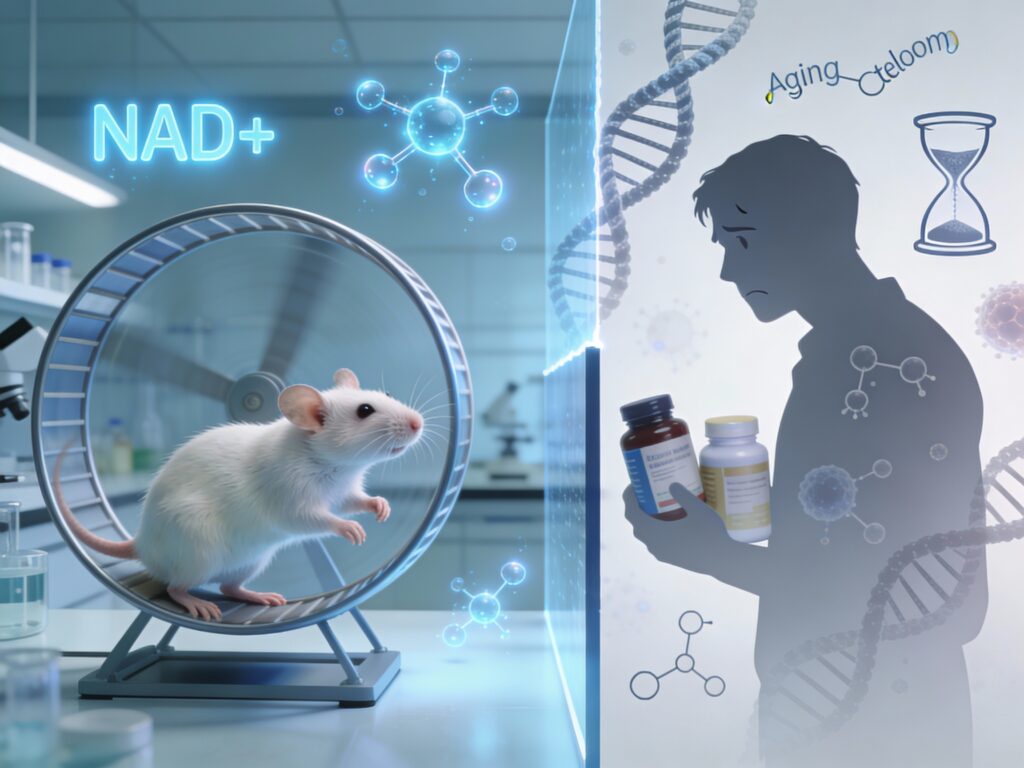
The foundational animal studies that generated NMN enthusiasm are genuinely impressive. The landmark 2016 Mills et al. study published in Cell Metabolism (Mills KF, et al. Cell Metabolism. 2016;24(6):795-806) demonstrated that twelve months of continuous NMN administration prevented virtually every hallmark of aging in mice. The researchers tracked energy metabolism, insulin sensitivity, exercise capacity, eye function, and bone density as mice aged, and the NMN-treated animals maintained youthful function while controls declined normally. The effect size was extraordinary: a single week of NMN supplementation restored a 22-month-old mouse’s muscle physiology to a 6-month-old level—roughly equivalent to reverting a 70-year-old person back to age 20. Subsequent mouse studies confirmed benefits across different tissues and aging models. The mechanism appeared elegant and replicable. NAD+ levels decline with age in all mammals studied. Sirtuins (SIRT1-7 proteins) are critical longevity regulators that require NAD+ as a cofactor. Therefore, restoring NAD+ should activate sirtuins and reverse aging phenotypes. The logic was sound, and the animal evidence was consistent.
When human trials finally emerged, however, the translational gap became apparent. The most frequently cited human study—Yoshino et al., published in Science in 2021 (Yoshino M, et al. Science. 2021;372(6547):1224-1229)—appeared to show that NMN improved insulin sensitivity in prediabetic women. But closer examination revealed a critical issue: the randomization failed. The NMN group began the study with 6.3% hepatic lipid content, while the placebo group had 14.8%—meaning the NMN group was roughly 2.3 times healthier at baseline before any supplementation occurred. This baseline imbalance fundamentally undermines the conclusion. As additional human studies accumulated through 2022 and 2023, a clearer pattern emerged. A comprehensive analysis of the thirteen published human NMN trials reveals a striking pattern: while NMN consistently raises blood NAD+ levels across all studies, it produces essentially zero effects on the metabolic measures that matter most. Fasting glucose showed no change. HbA1c showed no change. Insulin resistance (HOMA-IR) showed no change. Triglycerides showed no change. HDL and LDL cholesterol showed no change. Across twenty-eight separate metabolic outcomes measured in these studies, twenty-three demonstrated zero effect of NMN compared to placebo. The few studies showing positive results typically involved either baseline randomization problems, minuscule effect sizes, tiny sample sizes under thirty participants, or measures of questionable clinical relevance.
This human data contrasts sharply with the mouse studies because of a fundamental physiological difference: NMN successfully raises NAD+ levels in mouse tissue throughout the body, but in humans, it raises blood NAD+ without apparently increasing NAD+ in muscle tissue—the tissue where NAD+ depletion actually drives age-related metabolic dysfunction. This explains why mice show benefits across every measure while humans show almost none. The translation failure is not because the NAD+ hypothesis is wrong; NAD+ decline is real and documented. Rather, oral NMN supplementation in humans fails to deliver NAD+ to the tissues where it matters. The molecule apparently undergoes conversion in the gut and liver, loses its form, or cannot cross the biological barriers necessary to accumulate in muscle tissue the way it does in controlled laboratory mice. The gap between controlled laboratory environments with genetically identical mouse strains and real human populations with genetic diversity, variable lifestyles, and complex tissue barriers is simply too large for the animal data to predict human outcomes.
The practical implications are significant. Supplement companies have marketed NMN at premium prices ($600-1200 annually) based on compelling mouse studies that simply do not translate to humans. Longevity enthusiasts have spent considerable money and effort on a supplement that, based on the best available human evidence as of late 2023, produces no measurable metabolic benefits for healthy individuals. For those genuinely seeking to optimize NAD+ and healthspan, the evidence increasingly points toward interventions with demonstrated human efficacy: regular resistance training, which activates AMPK and PGC-1α pathways that naturally elevate NAD+; periodic fasting or caloric restriction, which robustly increases NAD+ via NAMPT activation; adequate sleep (7-9 hours), which maintains circadian NAD+ rhythms; and stress management, which prevents cortisol-driven NAD+ depletion. These lifestyle approaches activate the same NAD+-dependent sirtuins that NMN aims to activate, but they do so through the body’s natural regulatory mechanisms rather than crude supplemental dosing. The NMN story serves as a cautionary tale about the dangers of extrapolating from animal research to human health claims. When reviewing longevity supplements and anti-aging interventions, the critical question should not be “does this work in mice?” but rather “what does the actual human evidence show?” The answer for NMN, based on thirteen published human trials through 2023, is clear: despite compelling mouse data and an elegant mechanism, the human evidence demonstrates that NMN does not meaningfully improve metabolic health or aging markers in healthy adults.